
Breast Lift
Breast lift surgery raises and firms the breasts by removing excess skin and tightening the surrounding tissue to reshape and support a new uplifted and rejuvenated breast contour.
Women who require breast lift surgery usually have breasts that sag due to ageing and/or having breastfed. Breasts of any size can be lifted but the best results are usually achieved in women with small, sagging breasts. Sometimes you may also wish to increase the size of the breast in which case combining the procedure with a breast augmentation may be appropriate.

Breast Lift Surgery
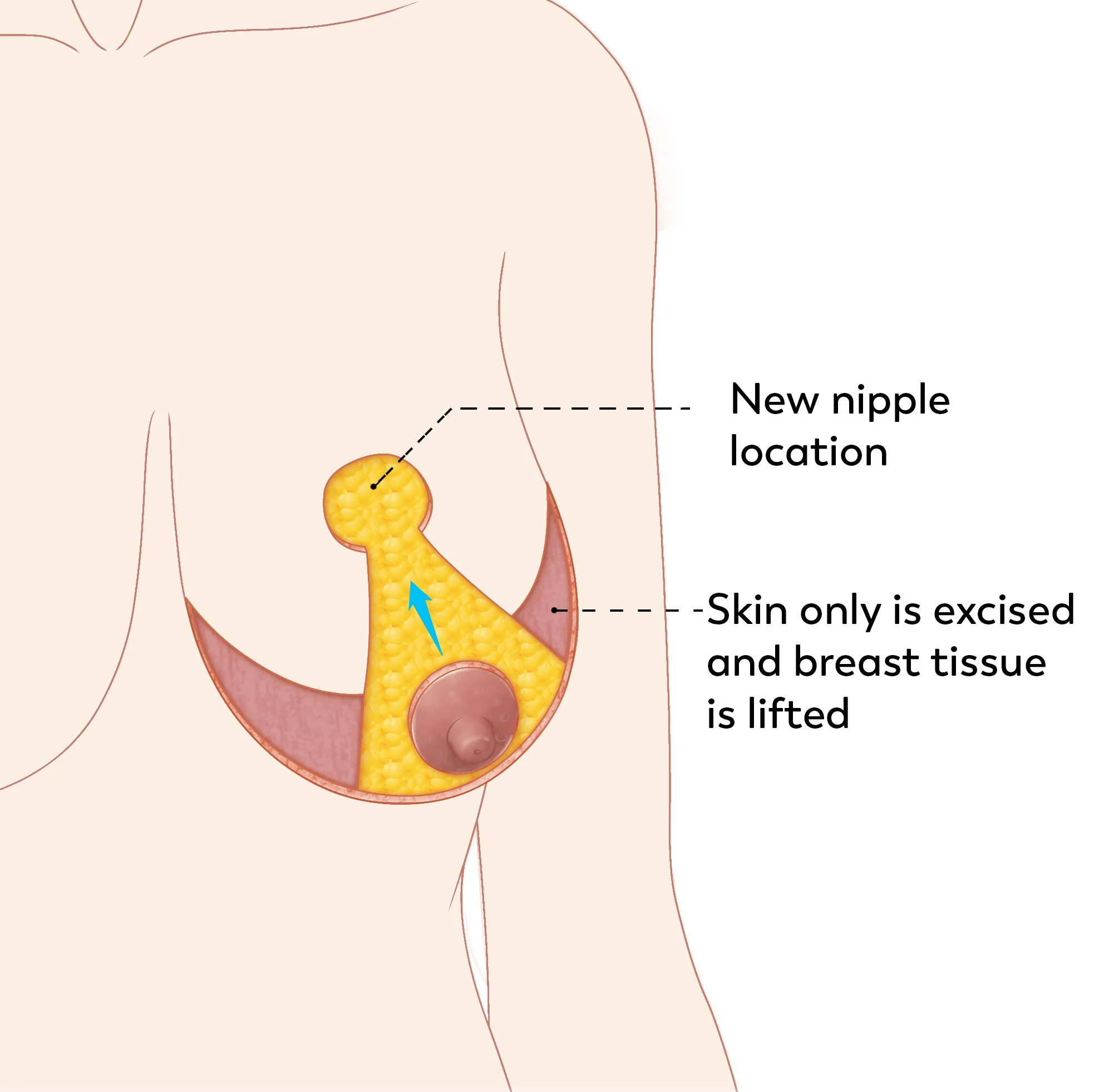
Breast lift surgery involves excision of excess skin, re-draping of the remaining skin, repositioning of the nipple +/- reduction of the nipple.
The “vertical scar” technique is the most commonly used and it results in a scar around the nipple and a scar going vertically down the breast. Sometimes it is also necessary to excise in a straight line below the breast.
Breast lift surgery can also be performed in conjunction with a breast augmentation for patients wishing fuller breasts using implants.
Your Hospital Stay
The breast lift procedure is usually carried out in a private hospital under general anaesthetic as a day procedure.
Your Recovery
Following your procedure, dressings will be applied to the incisions and you will need to wear a support bra for 2-4 weeks to minimise swelling and support your breasts as they heal. A return to all normal activities is expected within 6 weeks.
Risks of Breast Lift Surgery
Key risks specific to breast lift surgery are:
Asymmetry of the breasts
Breast pain
Decreased nipple and areola sensation
Additional general risks inherent in undergoing surgery and anaesthesia are explained at the time of consultation.
Frequently Asked Questions
-
The breasts of a patient who presents for breast lift surgery may have all or some of the following features:
breasts have lost shape and/or volume
breasts have a flatter, elongated shape or are pendulous
when unsupported, nipples fall below the breast crease
nipples and areolae point downward
areolae have become enlarged
one breast is lower than the other
-
These are just a few of the common causes:
Pregnancy
Breastfeeding
Weight fluctuation
Ageing
Genetic factors
-
No – not significantly. If you want the breast to look noticeably fuller, you will require the insertion of an implant in addition to the breast lift procedure. It is quite common to combine a breast lift procedure with an augmentation.
-
There will be a scar around the nipple, +/- vertically down from the nipple to the lower fold of the breast and possibly in the lower fold of the breast.
-
Possibly. Breast lift surgery doesn’t significantly alter the breast tissue remaining, so shouldn’t have a significant impact on the ability to breastfeed.
-
The breast skin may stretch with pregnancy and breastfeeding and hence reverse some of the effects of the breast lift procedure.
-
The breast lift procedure is usually carried out in a private hospital under general anaesthetic as a day procedure.
Following your procedure, dressings will be applied to the incisions and you will need to wear a support bra for 2-4 weeks to minimise swelling and support your breasts as they heal. A return to all normal activities is expected within 6 weeks.
Glossary of Medical Terms
Mastopexy
The surgical name for breast lift procedure
Vertical scar technique
The breast reduction technique is possible for some small to medium breast reductions that result in a scar from the underside of the nipple down to under the breast but which does not result in a horizontal scar under the breast.
Loss of nipple-areola, nipple-areola too high or low, and skin loss – especially in smokers
Possible difficulty with breastfeeding
Altered sensitivity of mammography to detect breast cancer
Additional general risks inherent in undergoing surgery and anaesthesia are explained at the time of consultation.
RANDWICK PLASTIC SURGERY