

Breast Reconstruction
Breast Reconstruction refers to breast surgery whose goal is to restore the natural shape and look of a breast that has been removed due to cancer or other disease.
Reconstruction of a breast that has been removed due to cancer or other disease is one of the more complex yet rewarding surgical procedures to perform.
Planning Your Surgery
There are 3 key decisions that need to be made when planning this surgery:
1. Which surgical technique is most appropriate?
There are several different techniques we can use and the best choice will depend on your preference, your body shape, age and what stage you are at with your cancer treatment.
2. One or both?
If only one breast is affected by cancer treatment and removed, we might decide to operate on the other breast as well to improve breast symmetry.
3. Timing?
You might decide to have the removal of the breast and the breast reconstructive surgery on the same day, or to allow some time between removal of the breast cancer and the reconstruction of the breast.
These key decisions of technique and timing are made together after we have taken time to discuss and consider all of the available options.
The decisions are ultimately yours but we make sure that you are comfortable with your decision and truly understand all of the options available to you.
Breast Reconstruction Surgery
The new breast mound is created by using either your own body tissue, an implant or both.
When using your own body tissue to create the breast mound, it is usually taken from the belly but it can also come from the buttocks or back. As the breast is reconstructed from natural tissue, the results have a more natural feel and appearance. This technique is more complex. Surgery and recovery time is usually longer.
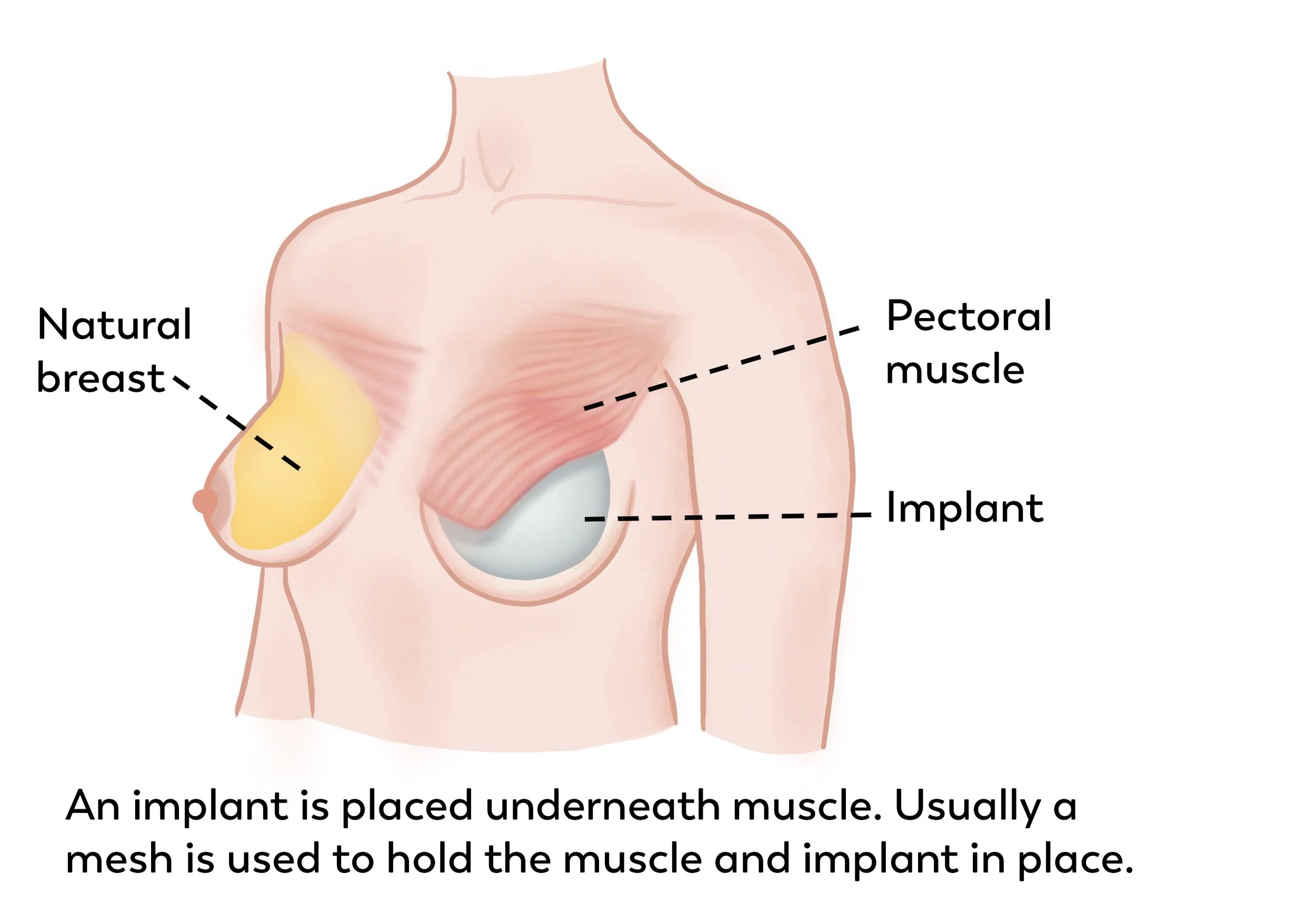
Implant reconstruction can be performed in a single stage (one operation) or two stage (two operations). This is dependent on implant size, quality of the skin and patient preference.
In two stage surgery, the first operation is when an expander is placed under the skin and muscle at the site of the new breast. This is inflated with salt water injections over a period of weeks.
At the second operation, usually 3 months later, the expander is replaced with a permanent silicone implant. Sometimes a muscle from the back is used to assist in implant based reconstruction. This may be required in a single stage or two stage surgery.
Surgery to the other breast is often required or requested. This can be augmentation, breast lift or breast reduction.
Reconstruction of the nipple and areola is usually performed some months later using the skin at the site of the nipple position. The reason for the delay is that the new breast at first will be higher than the other side so allowing time for it to settle means you have a better long term result. Tattooing can be used after this to give the skin a better match to the other side.
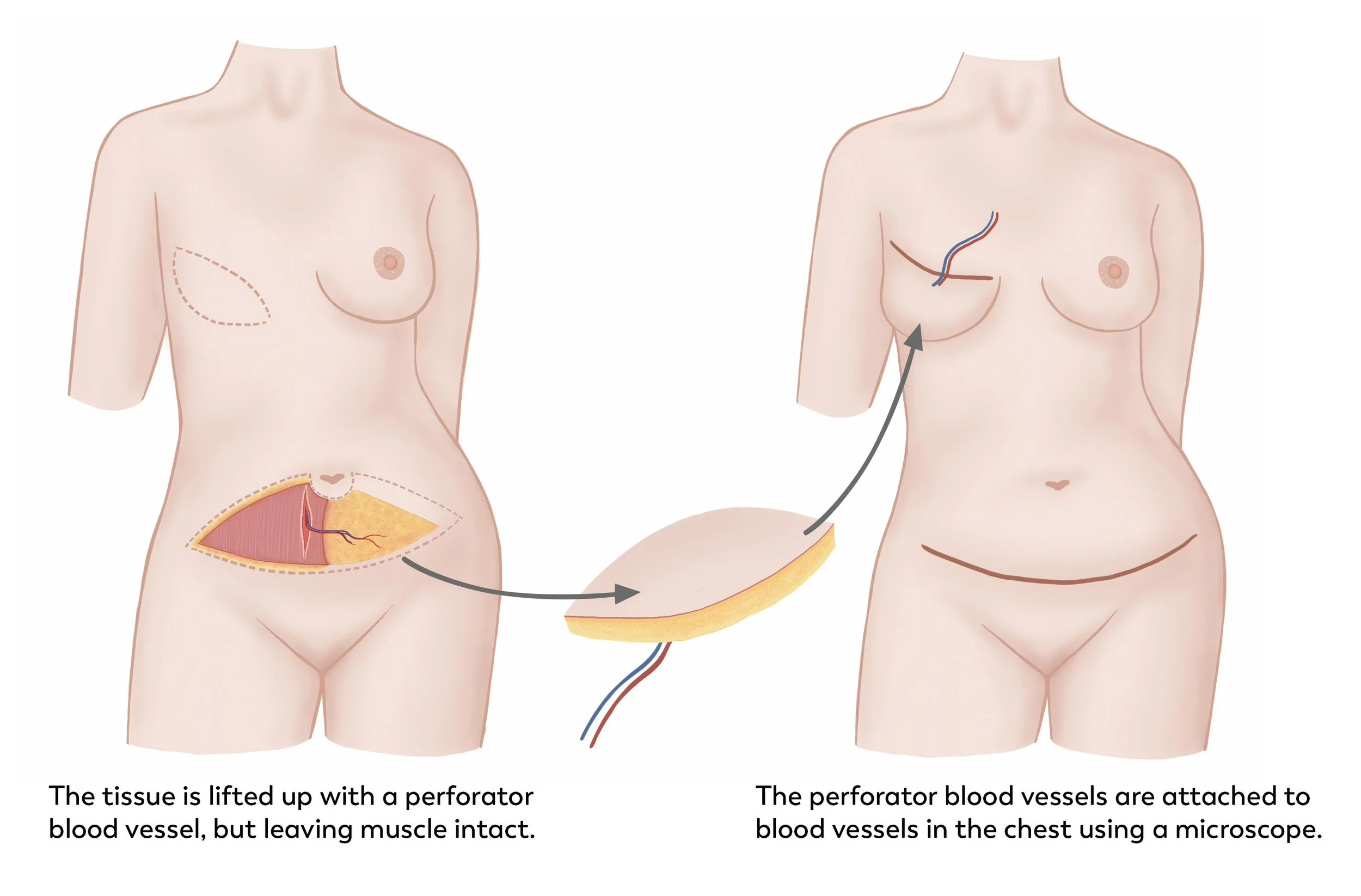
Perforator Flap Breast Reconstruction (DIEP)
Implant Breast Reconstruction
Risks of Breast Reconstruction
Key risks specific to Breast Reconstruction surgery are:
NOTE: Some of these are very technical, so don’t think you need to understand any of it now, we will explain everything to you during the consultation process.
Capsular contracture
Expander rupture/deflation
Skin wrinkling and rippling
Loss of nipple-areola, skin loss and wound breakdown – especially in smokers
Implant malposition
Fat necrosis
Loss of volume
Pain and lumpiness
For free flap techniques: complete or partial loss of flap- early or late
Donor site complications including infection and wound breakdown
Additional general risks inherent in undergoing surgery and anaesthesia are explained at the time of consultation.
Frequently Asked Questions
-
Breast reconstruction surgery is carried out in a hospital under general anaesthesia with usually a 3-10 night hospital stay: the stay being usually much shorter when the least complex surgical technique is chosen. Recovery time off work is usually in the range of 4-6 weeks for most of my patients.
-
We most commonly use implant or more complex free tissue transfer techniques of breast reconstruction.
-
We use the single-stage or two-stage implant reconstruction depending on your situation. Single-stage implant reconstruction is usually only possible at the time of mastectomy (called immediate recon ). This involves insertion of the implant after the breast has been removed and often requires the use of a skin substitute material placed under the chest muscle to help protect the implant. The two-stage implant reconstruction uses a temporary implant placed under the muscle which is gradually expanded to stretch the tissues over several months and is then exchanged for a long-term implant during a second operation.
-
Free tissue transfer breast reconstruction techniques are where the reconstructed breast is created out of only your tissue. This tissue is most frequently taken from the abdomen. The tissue is detached from the body with blood vessels attached which are then repaired to blood vessels in the chest under a microscope (microsurgery). The tissue then has its own blood supply on the chest wall and can be shaped to recreate the breast. This is known as a free flap. The flap from the abdomen is called a TRAM flap (which contains some muscle) or DIEP flap (no muscle is taken). This operation is carried out in one stage but requires a longer stay in the hospital and takes longer to recover from than an implant reconstruction.
-
This is where an implant is used, but it is combined with the use of some of your tissue (autologous). The most common tissue used is the latissimus dorsi muscle from the back. This is transferred to the mastectomy site and used to help cover an implant. This technique would be used most frequently in patients who have had radiation treatment and do not wish to have a flap reconstruction or have had complications with previous reconstructions.
-
Breast reconstruction surgery is sometimes carried out on the same day as the mastectomy (called an immediate reconstruction) or once the mastectomy wound has healed (called a delayed reconstruction). Some patients prefer immediate reconstruction as they combine breast cancer and reconstruction surgery in one hospital stay, waking up with a breast mound already in place and don’t have to experience having no breast. Outcomes are reported to be better with immediate reconstruction, but this technique is not possible for all women. If the breast reconstruction is to be delayed it can be performed at any time after breast cancer treatment is completed.
-
Women who have had a mastectomy of one breast will often require surgery on the other breast to gain better symmetry of shape and volume between the two breasts. The surgery to the other breast may be enlargement or reduction +/- breast lift as required
Glossary of Medical Terms
Mastectomy
The medical term for the removal of a breast or breasts.
Free tissue transfer
Using your own tissue (usually from the abdomen) to create the new breast mound.
Immediate reconstruction
Where your breast reconstruction surgery occurs at the same time as your mastectomy.
Delayed reconstruction
Where your breast reconstruction surgery takes place months or years after your mastectomy.
Flap reconstruction
Where tissue is used from another place on your body to form a breast shape. This tissue consists of skin, fat, and sometimes muscle and usually comes from the belly, back, buttocks, or inner thighs.
TRAM flap
Transverse rectus abdominis myocutaneous flap – where the flap used to form the new breast is taken from the abdomen and includes some muscle.
DIEP flap
Deep inferior epigastric perforator flap – where the flap consists of the skin and fat with the blood vessels of the abdomen only and not the six-pack muscle.
Latissimus Dorsi flap
An oval flap of skin, fat, muscle and blood vessels from your upper back
RANDWICK PLASTIC SURGERY