
Dupuytren’s Disease
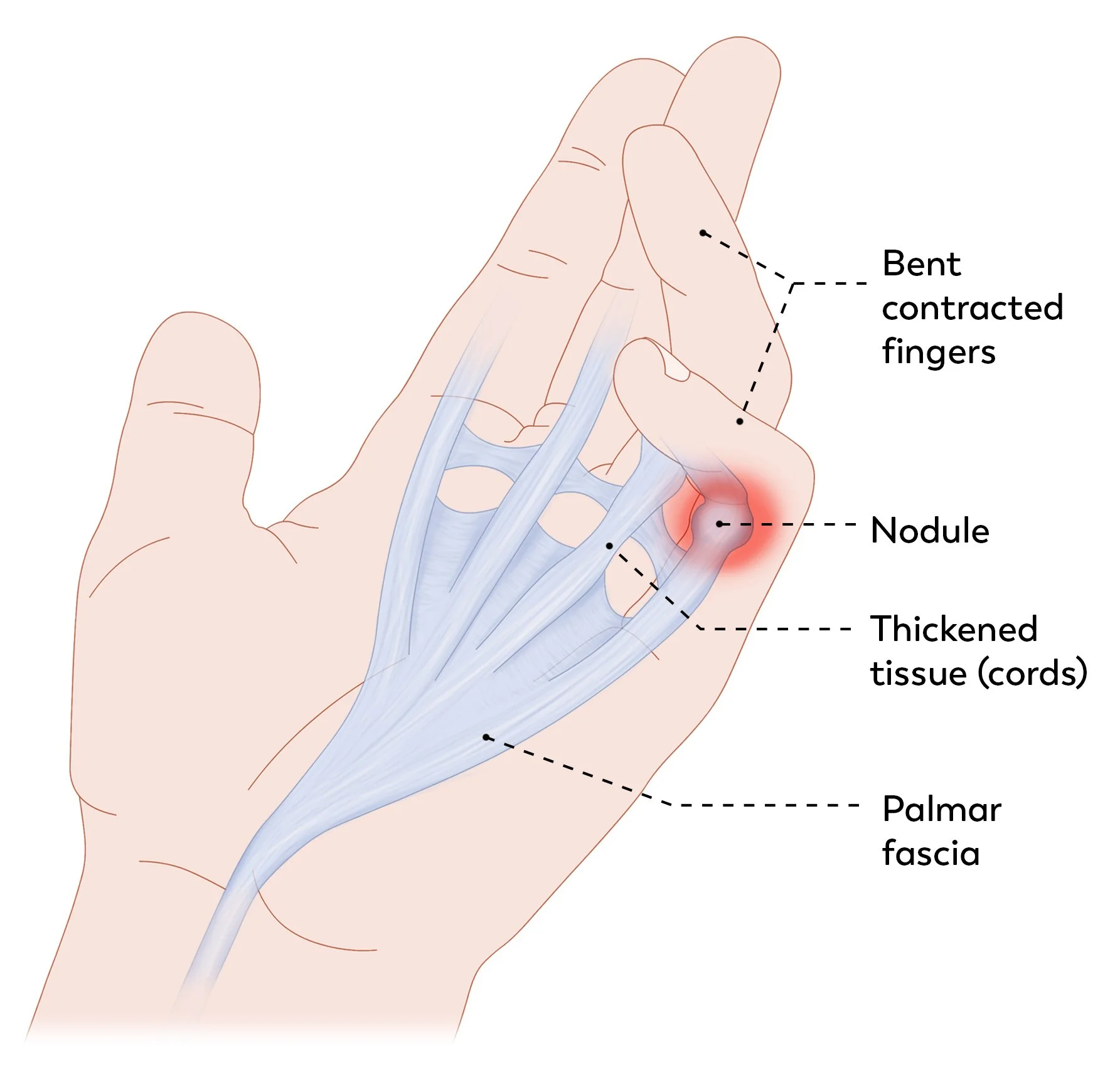
Dupuytren’s disease presents as an abnormal thickening of the tissue, nodules or cords just beneath the skin of the palm. This tissue layer is called the palmar fascia. It is not typically painful, but as the disease progresses it can cause the fingers to bend into the palm (contractures), causing difficulty with everyday activities.
Although the skin may become involved in the process, the deeper structures such as the tendons, are not directly involved.
Occasionally, the disease will cause thickening on top of the finger knuckles (knuckle pads).
This condition can also occur in the feet (plantar fibromatosis) but is less common.
The cause of Dupuytren’s is largely unknown. The problem is more common in men over age 40 and in people of northern European descent.
There is no proven evidence that hand injuries or specific occupations increase the risk of developing Dupuytren’s.

Non-Surgical Treatment of Dupuytren’s Disease
There are 3 non-surgical treatments that may be appropriate for mild or moderate Dupuytren’s disease and will usually offer short to medium-term relief:
Steroid Injections can be useful if pain or triggering in the hand are the predominant symptoms.
Fasciotomy is a minor procedure sometimes useful for Dupuytren’s disease to release contracture in the palm only. After local anaesthetic injection, a very fine pointed blade is used to cut through the tight cord/s. This is performed in rooms with local anaesthetic and can be combined with Xiaflex® treatment.
Xiaflex® is an enzyme that breaks down the Dupuytren’s disease tissue and can be used to release contractures in the hand. The treatment requires a fine needle injection and then manipulation a day or so later. It enables you to have your Dupuytren’s treated without going into hospital and without general anaesthetic.
Patients with more advanced contractures may require surgery in order to improve function.
Surgical Treatment of Dupuytren’s Disease
Surgical treatment of Dupuytren’s disease involves releasing the contracture and removing some of the diseased fibrous tissue, sometimes including skin.
Sometimes a skin graft or flaps are also required to help relieve tension on the skin.
The nerves to the fingertips are often wrapped up in the contracture and may be damaged during surgery.
This is usually partial and temporary. Sometimes, it may not be possible to completely release all of the contractures.
Your Hospital Stay
Surgery for Dupuytren’s disease will usually be carried out as day surgery in a hospital.
Your Recovery
A dressing will be worn for a few weeks post-surgery. You will also need hand therapy to assist with movement and to help prevent further contracture.
Most patients will need to wear a splint at night for six weeks up to three months.
Risks of Dupuytren’s Disease Surgery
Key risks specific to Dupuytren’s Disease surgery are:
postoperative joint stiffness and loss of preoperative flexion
pain and discomfort around the incisions
some stiffness of the tendons remaining permanently
it may not be possible to fully straighten the fingers with surgery
delayed wound healing, particularly if skin grafts are required
the disease may recur and fingers may begin to bend into the palm once again
Additional general risks inherent in undergoing surgery and anaesthesia are explained at the time of consultation.
Frequently Asked Questions
-
The initial lumps may produce discomfort that usually resolves itself, but Dupuytren’s disease is not typically painful.
-
Surgery for Dupuytren’s disease will usually be carried out as day surgery in a hospital.
A dressing will be worn for a few weeks post-surgery and will also need hand therapy to assist with movement and to help prevent further contracture.
Most patients will need to wear a splint at night for six weeks up to three months.
-
Despite surgery, the disease process may progress or present in other areas of the hands causing further contractures. This is usually a slow process occurring over years.
Glossary of Medical Terms
Contracture: A decrease in joint movement
Plantar Fibromatosis: Another name for Dupuytren’s disease when it occurs in the sole/s of the feet
Fasciotomy: A surgical procedure where the fascia is cut to relieve tension or pressure
Xiaflex®: An enzyme that can be injected to break down the Dupuytren’s disease
RANDWICK PLASTIC SURGERY