
Ganglion Cysts
Ganglion cysts are common lumps that appear on the hand and wrist which can fluctuate in size.
They are generally not painful but are often annoying due to their appearance.
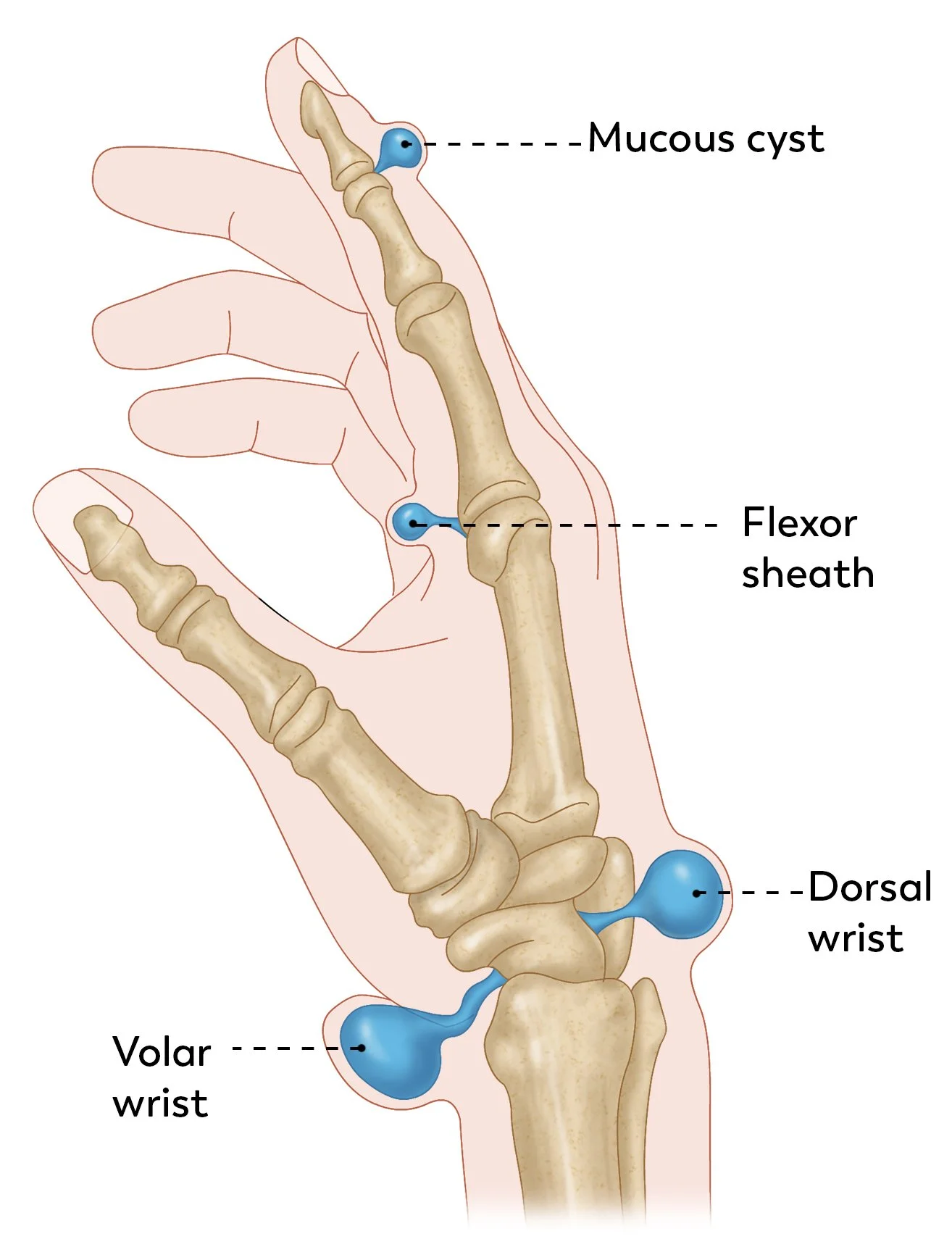
The cysts typically occur at 4 sites:
the back of the wrist (dorsal)
the front of the wrist (volar)
the base of the finger (flexor sheath)
the end joint of the finger (mucous cyst)
Ganglion Cysts can usually be diagnosed by examination ie without X-ray. An ultrasound is often requested to confirm the diagnosis and may be helpful if the ganglion is very small or to help outline the full extent of the ganglion.
X-rays may be used to look for any arthritis or other joint problems.

Non-Surgical Treatment
If the ganglion is painless and not causing any problems it is feasible to let it be as it may even disappear spontaneously requiring no treatment.
Persistent ganglions which are becoming troublesome can initially be treated with a steroid injection as this can help reduce or eliminate the ganglion.
If the cyst remains after a steroid injection it can be removed surgically.
Surgery
Surgery is performed by creating an incision directly over the swelling and removing both the ganglion and a small cuff of the joint capsule from which the ganglion arises.
This is generally performed as a day surgery in a hospital under general or local anaesthetic.
Your Hospital Stay
Surgery to excise ganglion cysts can be performed under general or local anaesthetic and is performed as day surgery in a hospital.
Your Recovery
The wound usually heals quickly and symptoms are often relieved within the first few weeks.
The dressing is kept in place for 5-7 days post-surgery and patients can use their hands for gentle activities in the few weeks post-surgery.
Risks of Ganglion Cyst Surgery
Key risks specific to Ganglion Cysts surgery are:
pain and discomfort around the incision
wound infection (treatment with antibiotics may be needed)
Additional general risks inherent in undergoing surgery and anaesthesia are explained at the time of consultation.
Frequently Asked Questions
-
Ganglions are most commonly present on the back or the front of the wrist and on the bone or end joint or the finger.
-
Ganglions usually arise due to some degeneration in the lining of a joint in the hand or wrist.
-
Although most ganglions can be diagnosed by examination alone, an x-ray is useful if arthritis or other joint problems are suspected.
Often a request for an ultrasound is required to assist with diagnosis and possibly for a steroid injection at the same time.
-
No. If a ganglion is causing you no pain then there is no need to treat it – unless of course you are concerned due to its appearance
-
Yes. Usually, ganglions can be treated with a steroid injection before considering surgery as this sometimes helps to reduce and eliminate the ganglion.
-
The average risk of return of a ganglion after surgical removal is around 10%.
Glossary of Medical Terms
Ganglion: An abnormal non-cancerous swelling on a tendon sheath
Cyst: A closed sac-like structure that contains liquid gas or semisolid substance

RANDWICK PLASTIC SURGERY