

Trigger Finger
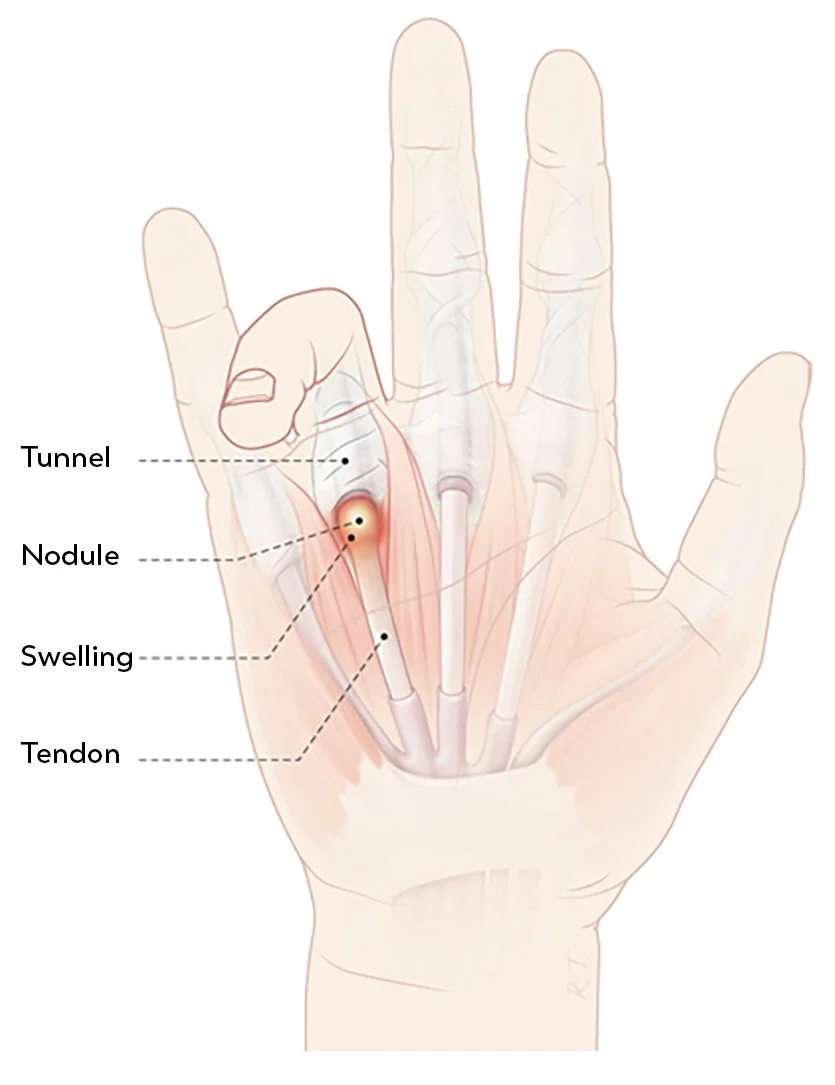
Trigger finger (‘Stenosing Tenosynovitis’) presents as pain or clicking in the palm on the bending of the fingers due to catching and/or irritation of tendons in the palm. Swelling can develop in the tendon creating a nodule which causes more irritation and further swelling. Ultimately, the swelling may get stuck in the tunnel that the tendon passes through, causing locking of the finger.
Non-surgical treatment
Relief of trigger finger may be achieved with rest, anti-inflammatory tablets and sometimes a splint. A steroid injection can relieve symptoms and sometimes ‘cure’ the condition.
If symptoms persist or recur, then surgery is usually recommended.
Surgery
Surgery is by an incision in the palm. The tunnel is visualised and divided, allowing the tendon to move freely. Occasionally, inflammatory tissue may need to be excised (called synovectomy).
This is usually performed in a hospital as a day surgery under local anaesthetic and sedation.
Your Recovery
The finger can be moved immediately after surgery. The dressing is removed at the first appointment and usually recovery is complete within 2-3 weeks. No splints are required.
Risks of Trigger Finger Surgery
Key risks specific to trigger finger surgery are:
weakness of the hand due to injured tendons or nerves
recurring or worsening symptoms
numbness in hand
Additional general risks inherent in undergoing surgery and anaesthesia are explained at the time of consultation.
Frequently Asked Questions
-
Usually trigger finger affects just one finger but it can affect many fingers and at different times.
-
Yes. We often suggest trying a combination of rest, anti-inflammatory tablets, a splint and/or a cortisone injection prior to recommending surgery.
-
No, it is usually a condition that can wait weeks to months for treatment.
-
The finger can be moved immediately after surgery and the hand can be used as it feels comfortable to do so.
-
The finger can be moved immediately after surgery. The dressing is removed at the first appointment and usually recovery is complete within 2-3 weeks. No splints are required.
Glossary of Medical Terms
Tendon: The tissue that attaches a muscle to a bone
Stenosing Tenosynovitis: Trigger finger or thumb
Synovectomy: Removal of tissue
Steroid Injection: Injections usually comprised of cortisone medication and a local anaesthetic
Pulley: Is another term for the tunnel which the tendon passes through
RANDWICK PLASTIC SURGERY